Takamasa Momose
Profile

Featured Publications
Research and Teaching Interests
Main Page
Research in Professor Momose's group aims to explore the physics and chemistry of extremely cold molecules, and use cold and ultracold molecules for various applications in a wide range of scientific domains. In chemistry, we are exploring exotic chemical dynamics intrinsic to cold molecules. The nature of chemical reactions at low temperatures may be significantly different than those at above room temperature. Quantum effects, emerging from thermal averages, such as tunneling, resonance effects, and the increase of the wave nature of molecules becomes more pronounced at low temperatures. In Physics, we are applying cold molecules for the study of symmetry breakdown in nature. We are especially interested in parity violation in chiral molecules, which may be the source of homochirality of bio-molecules. Although it is still challenging to make cold molecules of chemical interest, recent technical advancements in cooling and trapping of molecules below 1K, including our contributions, allow for their application in various topics in physics and chemistry, which would offer a completely new field of research in physical chemistry and chemical physics.
Currently, various apparatuses for making cold and ultracold molecules are operational in Prof. Momose's laboratory in order to explore the properties of cold molecules below 4 K. They include Zeeman and Stark decelerators, counter rotating nozzles, microwave molecular traps, and parahydrogen and superfluid helium matrix systems. All the projects on cold molecule research are supported by CFI (Canada Foundation for Innovation) under CRUCS (Canadian Centre for Researches on Ultra-Cold Systems) and CHIROS (Chirality Research on Origins and Separation).
Prof. Momose is also involved in research projects in sub-atomic physics (SAP) for the study of fundamental symmetries.
The projects we are actively working on include:
(1) Deceleration and trapping of cold free radicals
(2) High resolution matrix isolation spectroscopy of molecules in parahydrogen crystals and superfluid helium nano-droplets.
(3) Parity violation in chiral molecules and the search for the origin of homochirality
(4) Measurement of the electric dipole moment (EDM) of the neutron (TUCAN at TRIUMF) for CP violation
(5) Laser cooling of antihydrogen (ALPHA at CERN) for CPT violation and matter-antimatter gravity measurements.
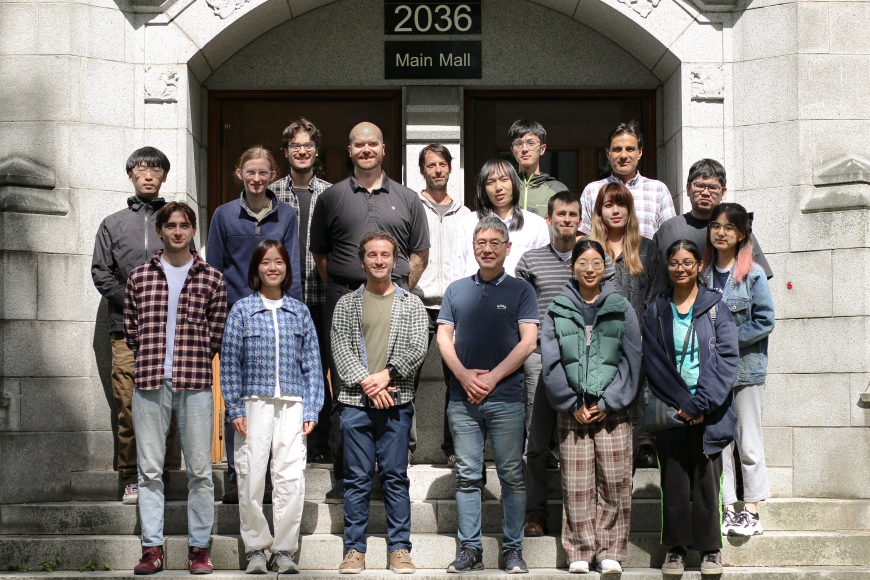
2024 Summer
Contact
Curriculum Vitae
B.Sc, Kyoto University, Japan (1984); Ph.D., Kyoto University, Japan (1991); Postdoctoral Fellow, The University of Chicago (T. Oka, 1991-93); Assistant Professor, Kyoto University (1988-93); Lecturer, Kyoto University (1993-95); Associate Professor of Chemistry, Kyoto University, (1995-2005); PRESTO fellow, Japan Science and Technology Corporation (JST) (1998-2001); Associate Professor, Fukui Institute of Theoretical Chemistry, Kyoto University, (Joint Appointment, 2003-2005); Professor, UBC (2005 -); The Chemical Society of Japan Young Chemists Award (1995); The PCCP Lectureship (Royal Society of Chemistry, 2015); G.C. Pimentel Award for advances in Matrix Isolation Spectroscopy (2016); The Spectroscopical Society of Japan Award (2020)